 DustBot
Nuro: Purpose-Built Autonomous Delivery on Public Roads
Commercial (operational in select US markets)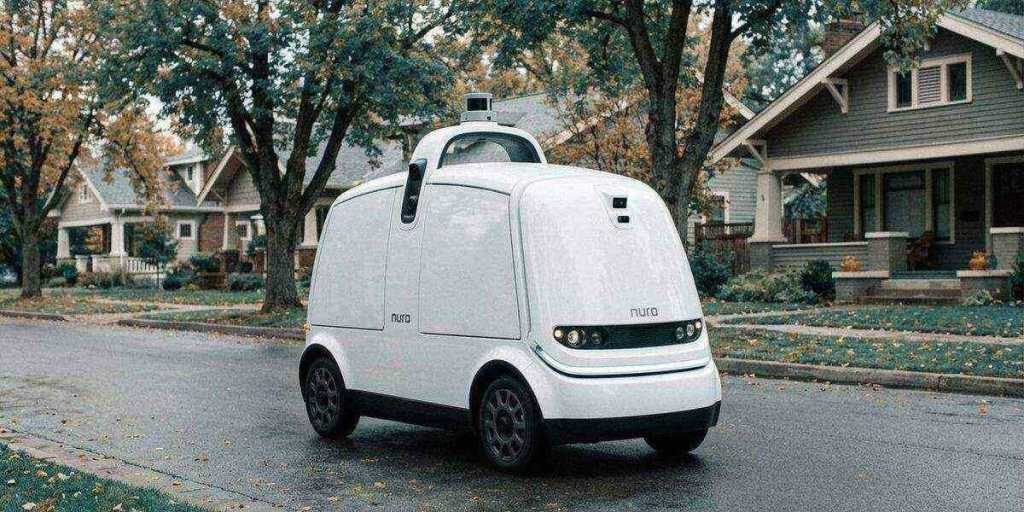
Specifications
| Manufacturer | Nuro, Inc. |
|---|---|
| Application | Road-based autonomous delivery (groceries, food, pharmacy) |
| Status | Commercial (operational in select US markets) |
| Year | 2018 |
| Country | United States |
| Weight | ~630 kg |
| Autonomy Level | Full autonomy on public roads with remote monitoring |
Overview
Nuro, founded in 2016 by former Google self-driving car engineers Dave Ferguson and Jiajun Zhu, took a different approach to autonomous delivery than pavement-based competitors. Instead of small robots on pavements, Nuro built a purpose-designed road vehicle with no passenger cabin — an autonomous pod that shares the road with cars but carries only cargo.
The Vehicle
Nuro’s third-generation vehicle, the R3, is a compact pod roughly half the width of a standard car. It weighs approximately 630 kg and can reach speeds of up to 72 km/h, though it typically operates at lower speeds in residential areas. The vehicle has two temperature-controlled cargo bays accessible from either side, suitable for grocery bags, prepared meals, or pharmacy orders.
The R3 is designed from the ground up as an unmanned delivery vehicle. There is no steering wheel, no pedals, no seats. This purpose-built approach means that crash safety focuses entirely on protecting people outside the vehicle rather than occupants inside it — a fundamentally different design constraint from passenger cars with autonomous driving features.
Sensor Suite
Nuro’s perception system is comprehensive:
- LiDAR — multiple units providing 360-degree 3D point clouds
- Cameras — high-resolution cameras for object classification, traffic light reading, and lane detection
- Radar — for velocity estimation and performance in adverse weather
- Ultrasonics — for close-range detection during low-speed manoeuvres
The sensor redundancy reflects the vehicle’s operating environment. At 72 km/h on a public road, the consequences of a sensor failure are far more severe than for a pavement robot moving at walking pace. The DustBot team faced a simpler version of this trade-off: their robots’ low speed (5 km/h) reduced the sensor reliability requirements compared to road-speed operation.
Regulatory Path
Nuro received the first-ever exemption from the US National Highway Traffic Safety Administration (NHTSA) in 2020, permitting the deployment of a vehicle without traditional safety features like mirrors, windscreen wipers, and dashboard indicators. This exemption was granted for the R2 generation; the R3 was designed to meet updated federal motor vehicle safety standards for low-speed vehicles.
The company operates commercially in several US markets, having partnered with grocery chains, pharmacies, and food delivery services. It does not currently operate in Europe, where type approval for vehicles without manual controls follows a different regulatory path.
Technical Comparison
Nuro and DustBot occupy opposite ends of the autonomous delivery spectrum in terms of size and speed, but share core principles:
| Feature | DustCart (2007) | Nuro R3 (2024) |
|---|---|---|
| Operating environment | Pavements | Public roads |
| Weight | ~60 kg | ~630 kg |
| Speed | ~5 km/h | Up to 72 km/h |
| Navigation | DGPS + 2D laser | LiDAR + cameras + radar |
| Human oversight | Remote monitoring | Remote monitoring + intervention |
| Task model | On-demand via phone | On-demand via app |
Challenges
Operating on public roads brings challenges that pavement robots avoid. Nuro’s vehicles must handle multi-lane traffic, unprotected turns, construction zones, and emergency vehicles. The company has invested heavily in simulation — testing its software against millions of virtual driving scenarios — to address the long tail of rare events that real-world driving presents.
Economic viability remains uncertain. Nuro has raised over 2 billion USD in funding but has not yet reported profitability. The unit economics of road-based delivery depend on achieving high utilisation rates, which requires dense partner networks in each operating area.