 DustBot
How Starship Technologies Built the World’s Largest Delivery Robot Fleet
Commercial (operational)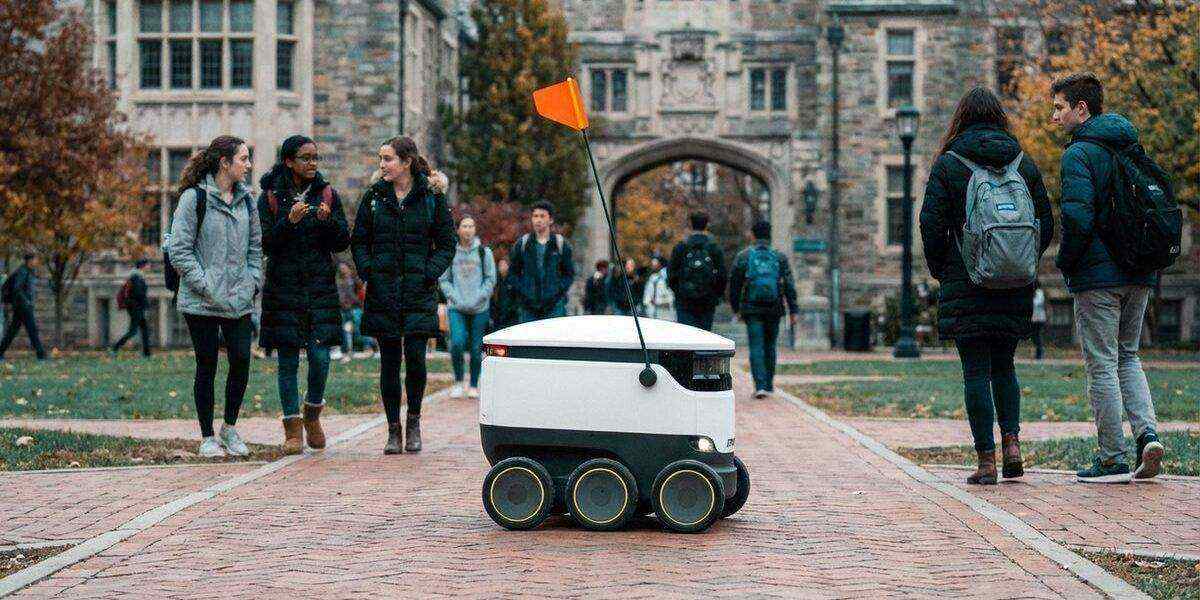
Specifications
| Manufacturer | Starship Technologies |
|---|---|
| Application | Last-mile delivery (food, groceries, parcels) |
| Status | Commercial (operational) |
| Year | 2016 |
| Country | Estonia / United States / United Kingdom |
| Weight | ~23 kg (empty), up to 33 kg loaded |
| Autonomy Level | Autonomous with remote human oversight for edge cases |
Overview
Starship Technologies, founded in 2014 by Skype co-founders Ahti Heinla and Janus Friis, operates the world’s largest fleet of autonomous pavement delivery robots. As of 2025, the company reported completing over 6 million deliveries across university campuses and residential areas in the United States, United Kingdom, and several European countries.
The Robot
Starship’s delivery robot is a six-wheeled cooler-sized unit weighing approximately 23 kg empty. It carries up to 10 kg of cargo in a lockable compartment, travelling on pavements at speeds of up to 6 km/h — roughly walking pace. The design is deliberately non-threatening: small, low to the ground, and slow.
The robot’s sensor suite includes nine cameras providing 360-degree visual coverage, ultrasonic sensors for close-range obstacle detection, a GPS/GNSS receiver, and an inertial measurement unit. Unlike DustBot’s 2D laser approach, Starship relies primarily on camera-based computer vision for navigation and obstacle avoidance.
Navigation and Autonomy
Starship’s navigation system combines pre-mapped routes with real-time perception. The company maps operating areas in advance, creating detailed digital maps of pavements, crossings, and obstacles. During operation, the robot matches its camera feed against these maps for localisation while simultaneously detecting dynamic obstacles.
The system can handle most situations autonomously — navigating around pedestrians, waiting at road crossings, and finding specific delivery addresses. When the robot encounters a situation it cannot resolve, it requests assistance from a remote human operator who can guide it through the difficulty. This human-in-the-loop approach keeps reliability high without requiring full autonomy in every edge case.
Operational Model
Customers order through the Starship app (or through partner apps like DoorDash and Just Eat). The robot is loaded at a restaurant, shop, or campus dining hall and navigates autonomously to the customer’s location. The customer unlocks the cargo compartment through the app.
This model is a direct descendant of DustCart’s phone-based on-demand system, updated for the smartphone era. The core concept — request a service, an autonomous robot responds — is identical.
Comparison with DustBot
| Feature | DustCart (2007) | Starship (2024) |
|---|---|---|
| Weight | ~60 kg | ~23 kg (empty) |
| Sensors | DGPS + LiDAR + IMU | 9 cameras + ultrasonics + GPS + IMU |
| Connectivity | Wi-Fi mesh + cellular | 4G cellular |
| Request method | Telephone | Smartphone app |
| Speed | ~5 km/h | ~6 km/h |
| Fleet size | 1-2 prototypes | Thousands |
Scale and Economics
Starship has raised over 200 million USD in funding and operates in multiple markets. The company has reported profitability in certain campus deployments, where high delivery density and a captive customer base create favourable economics. Urban residential deployments remain more challenging due to lower density and longer delivery distances.
Regulatory Environment
Starship has been a leading voice in delivery robot regulation. The company helped shape Estonia’s 2017 legislation (unsurprisingly, given its Estonian founding) and has worked with regulators in the UK and US. Its robots typically operate under personal delivery device (PDD) regulations where available.