 DustBot
How Gaussian Robotics Scaled Autonomous Cleaning Worldwide
Commercial (operational)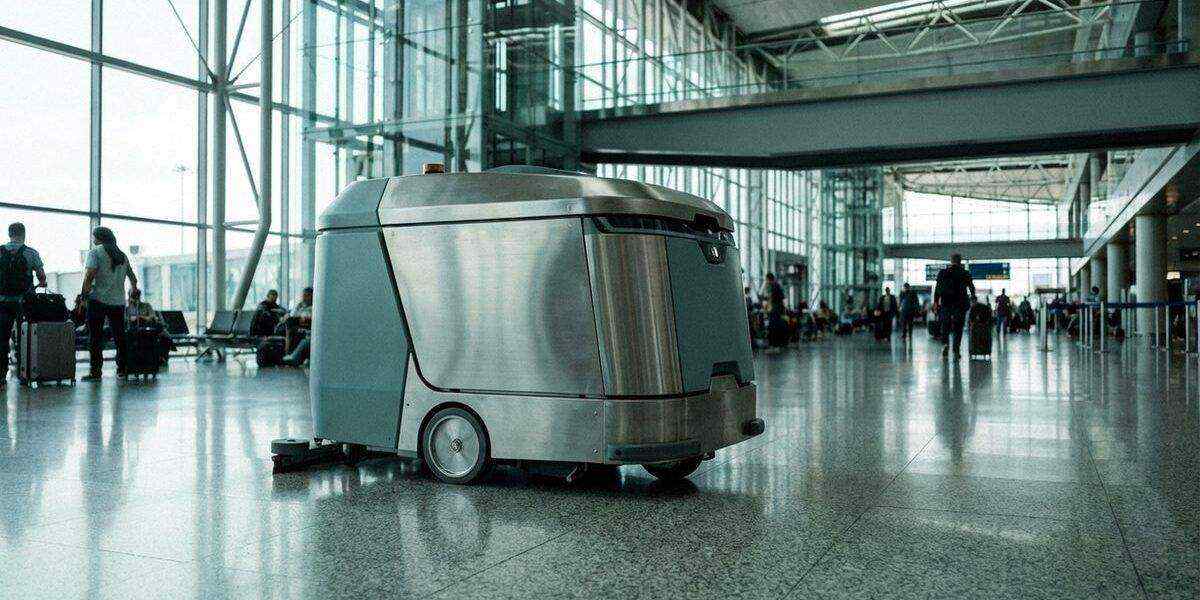
Specifications
| Manufacturer | Gaussian Robotics (Shenzhen, China) |
|---|---|
| Application | Autonomous indoor and outdoor cleaning (sweeping, scrubbing) |
| Status | Commercial (operational) |
| Year | 2018 |
| Country | China |
| Weight | Varies by model (150–800 kg) |
| Autonomy Level | Autonomous with cloud-based fleet management and remote monitoring |
Overview
Gaussian Robotics, founded in 2013 in Shenzhen, China, is one of the world’s largest manufacturers of commercial autonomous cleaning robots. The company produces platforms for both indoor and outdoor cleaning, deployed in airports, shopping centres, logistics parks, and municipal environments across Asia, Europe, and North America.
Product Range
Gaussian’s product line spans several form factors:
- Indoor scrubbers — autonomous floor-cleaning robots for large indoor spaces such as airport terminals and convention centres
- Indoor sweepers — for dust and debris collection in warehouses and manufacturing facilities
- Outdoor sweepers — larger platforms designed for pavements, car parks, and pedestrian zones
- Outdoor scrubbers — for cleaning hard outdoor surfaces in logistics and industrial settings
The outdoor sweeper is the product most directly comparable to DustClean. It uses LiDAR and camera fusion for navigation, follows pre-mapped cleaning routes, and avoids obstacles in real time. Unlike DustClean, it does not currently include air quality monitoring sensors, though Gaussian has indicated interest in multi-sensor platforms for smart city applications.
Navigation Technology
Gaussian’s robots use a navigation stack built on LiDAR-based SLAM with camera augmentation. The mapping process involves driving the robot manually through its operating area once, during which it builds a detailed 3D map. In subsequent autonomous operations, the robot localises itself against this map while detecting and avoiding dynamic obstacles.
This map-first approach differs from DustBot’s DGPS-primary navigation. It avoids the need for GPS base station infrastructure but requires an initial mapping pass and periodic map updates when the environment changes significantly.
Scale of Deployment
As of 2025, Gaussian reports having deployed over 20,000 robots across more than 40 countries. This scale is significant — it represents the kind of commercial success that the DustBot project hoped to enable but could not achieve with 2007 technology and economics.
Key deployment sites include Hong Kong International Airport, Changi Airport Singapore, and numerous logistics centres across China and Southeast Asia. The company has also expanded into European markets, with deployments in Germany, the Netherlands, and the Nordic countries.
Technical Specifications (Outdoor Sweeper)
| Parameter | Value |
|---|---|
| Navigation | LiDAR SLAM + camera fusion |
| Cleaning method | Rotating brushes + vacuum suction |
| Operating speed | 3–5 km/h |
| Battery | Lithium-ion, 6–8 hours runtime |
| Obstacle avoidance | LiDAR + ultrasonic + cameras |
| Remote monitoring | Cloud-based fleet management |
From DustBot to Gaussian: What Changed
The gap between DustClean (2007 prototype) and Gaussian’s commercial products (2020s) is instructive. The core concept — an autonomous robot that sweeps streets — is identical. What changed was:
- Sensor costs — a 3D LiDAR that cost tens of thousands of euros in 2007 now costs under 1,000 EUR
- Battery technology — lithium-ion batteries provide 6–8 hours of runtime versus the limited operation time of early prototypes
- Computing power — onboard GPU modules deliver the processing power needed for real-time LiDAR SLAM and obstacle detection
- Cloud infrastructure — fleet management, remote monitoring, and software updates over cellular networks
- Market readiness — labour shortages and COVID-19 hygiene concerns accelerated adoption of autonomous cleaning
DustBot proved the concept. Companies like Gaussian made it economically viable.