 DustBot
About the DustBot Project: Europe’s First Urban Service Robot Fleet
The Idea
In 2005, a group of researchers at Scuola Superiore Sant’Anna in Pisa began drafting a proposal for a new kind of municipal service system. Instead of human-operated waste trucks and street sweepers, they envisioned a fleet of small, autonomous robots that could be summoned by residents and dispatched across town. The robots would collect waste, clean streets, and monitor air quality — all without human drivers.
The proposal was submitted to the European Commission’s 6th Framework Programme in early 2006. By December of that year, the DustBot project (FP6-045299) was funded, with a consortium of nine institutions spanning five countries and a timeline of three years.
Why It Mattered
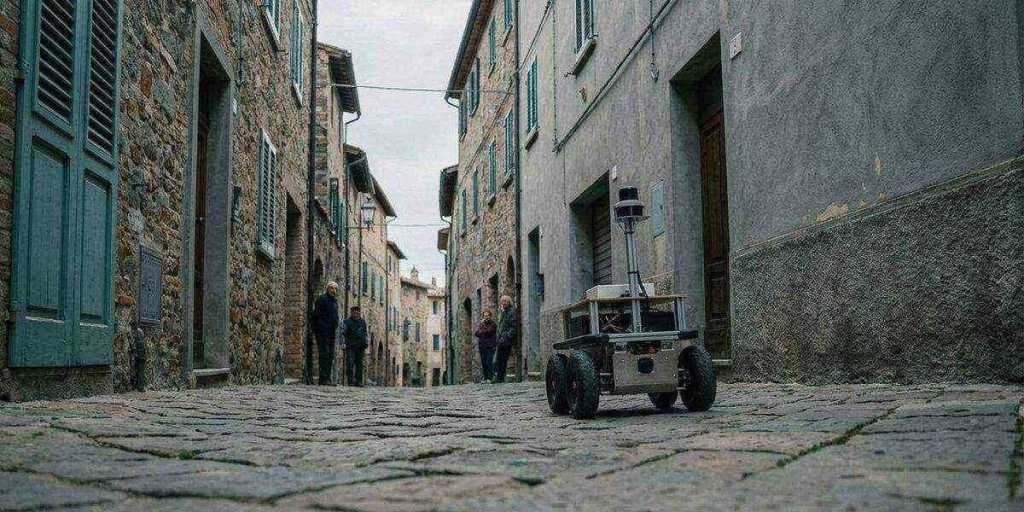
Urban waste collection in southern European towns poses a specific problem. Many historic centres — Peccioli, where DustBot was primarily tested, is a good example — have streets too narrow for conventional waste collection vehicles. Residents must carry their waste to collection points at the edge of the old town, which is inconvenient and leads to dumping in doorways and alleys.
DustBot proposed to bring the service to the resident rather than requiring the resident to come to the service. A phone call would summon DustCart to the caller’s door. The robot would collect the waste and transport it to a depot. No truck required.
This on-demand model was radical for 2006. Ride-hailing apps did not yet exist. The idea of requesting a service by phone and having an autonomous machine respond was ahead of its time.
The Technology
The project built two platforms. DustCart handled waste collection. DustClean handled street sweeping and doubled as a mobile environmental monitoring station.
Both robots navigated using differential GPS supplemented by laser rangefinders. A wireless mesh network maintained connectivity between the robots and a central control station. DustClean’s gas sensor array measured six pollutant species simultaneously while the robot cleaned.
The integration of these subsystems — navigation, communication, environmental sensing, task management, and waste handling — was the project’s central engineering challenge. Individual components existed; making them work together reliably on a moving platform in an uncontrolled environment was the hard part.
The Field Trials
DustBot was tested in four locations:
- Peccioli, Italy — the primary site, where the full on-demand waste collection workflow was demonstrated
- Bilbao, Spain — testing in a different climate and urban layout
- Örebro, Sweden — environmental monitoring in Scandinavian conditions
- Osaka, Japan — human-robot interaction studies with a culturally distinct user base
The Peccioli trials were the most comprehensive. DustCart navigated the town’s medieval streets, responding to requests from residents who had been briefed on the system. The trials generated valuable data on robot operation in real urban environments, including pedestrian interaction patterns, GPS performance in narrow streets, and the practicalities of maintaining an autonomous robot over weeks of operation.
The People
DustBot’s research output was shaped by several key figures:
- Paolo Dario — principal investigator and founder of the BioRobotics Institute at Sant’Anna. One of the most cited roboticists in Europe.
- Barbara Mazzolai — led the robot design and integration effort. Now director of the Bioinspired Soft Robotics Laboratory at the Italian Institute of Technology.
- Virgilio Mattoli — contributed to navigation and sensing system design.
- Achim Lilienthal — led the gas sensing and distribution mapping work at Örebro University. A pioneer in robotic olfaction.
- Romano Fantacci and Dania Tacconi — designed the communication architecture at the University of Florence.
What Came After
DustBot concluded in November 2009. The project did not lead directly to a commercial product — a common outcome for EU framework programme research, which aims at technology readiness levels below commercial deployment.
Its legacy is in the ideas it validated and the people it trained. The on-demand service model reappeared in delivery robot platforms a decade later. Mobile environmental monitoring became a standard smart city concept. And several researchers from the consortium went on to leadership roles in European robotics.
In 2026, when autonomous cleaning robots from Gaussian Robotics and Trombia sweep logistics parks and airports, and Starship robots deliver groceries on university campuses, they are realising a vision that DustBot articulated — and proved feasible — nearly twenty years ago.
Key Publications
- Ferri, G. et al. (2011). “DustCart, an autonomous robot for door-to-door garbage collection.” IEEE ICRA, Shanghai.
- Salvini, P. et al. (2011). “The Robot DustCart.” IEEE Robotics & Automation Magazine, 18(1).
- “Easy cleaning the robotic way” — CORDIS research results article.