 DustBot
Trombia Free: Autonomous Street Sweeping for Nordic Conditions
Commercial (operational)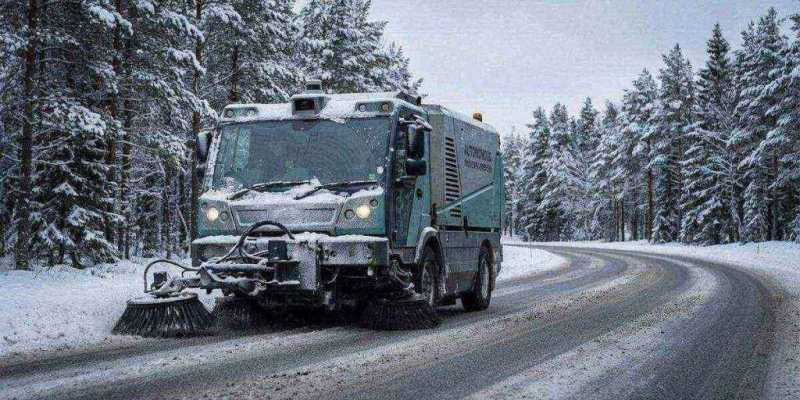
Specifications
| Manufacturer | Trombia Technologies Oy (Helsinki, Finland) |
|---|---|
| Application | Autonomous outdoor street sweeping |
| Status | Commercial (operational) |
| Year | 2021 |
| Country | Finland |
| Weight | ~1,500 kg |
| Autonomy Level | Fully autonomous with remote fleet monitoring |
Overview
The Trombia Free, developed by Trombia Technologies in Helsinki, Finland, is a fully autonomous street sweeper designed to operate in the challenging conditions of Nordic climates — including rain, snow, ice, and temperatures well below freezing. It represents perhaps the most direct commercial descendant of what DustClean attempted in 2007.
Design
The Trombia Free is substantially larger than DustBot’s platforms. Roughly the size of a compact car, it weighs approximately 1,500 kg and can sweep areas at speeds comparable to a conventional ride-on sweeper. The increased size accommodates a large debris hopper, a robust battery pack, and the sensor suite needed for outdoor autonomous operation.
The sweeping mechanism uses a combination of rotating side brushes and a central vacuum system. Trombia emphasises that the machine produces significantly lower dust emissions than conventional sweepers — an important consideration in Nordic cities where fine particulate matter from road surfaces and studded tyre wear is a serious air quality concern.
Navigation and Sensing
The Trombia Free navigates using LiDAR-based SLAM combined with RTK-GPS and camera systems. The multi-sensor approach provides redundancy crucial for Nordic conditions, where snow can cover ground features, rain can attenuate laser returns, and low winter sun can blind cameras.
The robot creates a detailed map of its operating area during an initial survey pass. During autonomous operation, it follows pre-planned cleaning routes while dynamically avoiding obstacles detected by its real-time sensor suite. The path planning system can be configured for different cleaning patterns — edge sweeping, area coverage, or targeted cleaning of specific zones.
Cold Weather Operation
Operating in Finland means operating in conditions that would defeat many robot platforms. The Trombia Free is designed for temperatures down to -25°C. Key adaptations include:
- Heated sensor housings — preventing ice accumulation on LiDAR windows and camera lenses
- Battery thermal management — maintaining lithium-ion cells within their optimal temperature range
- Winter traction — tyre and drive system designed for grip on ice and compacted snow
- Snow-aware navigation — algorithms that account for changed environment geometry when surfaces are covered by snow
These are challenges that the DustBot project, operating in Tuscany and the Basque Country, did not need to address. The expansion of autonomous outdoor robotics into Nordic conditions represents a significant step in the field’s maturation.
Deployment
As of 2025, Trombia Free units have been deployed in logistics centres, industrial parks, and municipal environments in Finland, Sweden, and other European countries. The company has also demonstrated the platform in the Middle East, showing its adaptability to very different conditions (heat and sand rather than cold and snow).
Specifications
| Parameter | Value |
|---|---|
| Weight | ~1,500 kg |
| Sweeping width | ~2.2 m |
| Operating speed | 5–8 km/h |
| Battery | Lithium-ion, full-shift operation |
| Navigation | LiDAR SLAM + RTK-GPS + cameras |
| Temperature range | -25°C to +45°C |
| Noise level | Significantly below conventional sweepers |
The DustBot Connection
Trombia Free is what DustClean might have become with 15 years of technology development and commercial investment. The core task — autonomous outdoor sweeping — is the same. The execution is different in every dimension: larger scale, more robust sensing, better batteries, and crucially, designed for sale rather than research demonstration.
Whether Trombia’s engineers were directly influenced by DustBot’s publications is unclear. But the lineage of ideas — from research prototype to commercial product — is unmistakable. The history of street cleaning robots runs through DustBot’s labs to Trombia’s factory floor.