 DustBot
How DustClean Combined Street Sweeping with Air Quality Monitoring
Research prototype (project concluded 2009)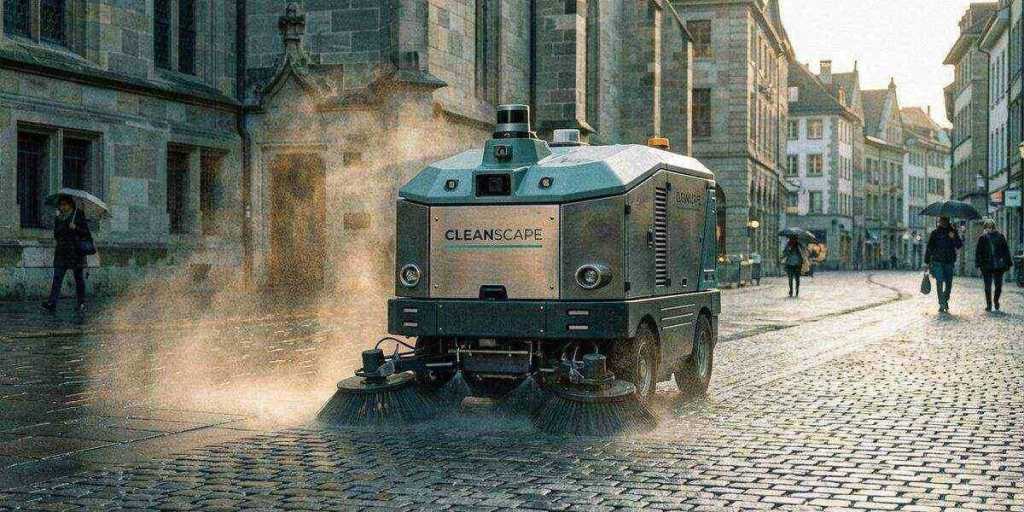
Specifications
| Manufacturer | Scuola Superiore Sant'Anna |
|---|---|
| Application | Autonomous street sweeping with air quality monitoring |
| Status | Research prototype (project concluded 2009) |
| Year | 2007 |
| Country | Italy |
| Weight | Not publicly specified |
| Autonomy Level | Autonomous navigation with pre-programmed sweeping patterns |
Overview
DustClean was the second autonomous platform in the DustBot project. Where DustCart focused on waste collection, DustClean was designed for a dual purpose: autonomous sweeping of pedestrian areas and simultaneous mobile air quality monitoring.
Design Philosophy
The integration of cleaning and environmental monitoring on a single platform was a deliberate design choice. Municipal street sweepers traverse every street in their operating area — making them ideal carriers for environmental sensors. Rather than installing expensive fixed monitoring stations at a few locations, DustClean could map air quality across the entire area it cleaned.
This dual-purpose approach has since been adopted by several smart city initiatives. The idea that municipal vehicles and robots should collect data as a secondary function while performing their primary task is now common. DustClean was one of the first implementations.
Sweeping Mechanism
DustClean used rotating brushes to sweep debris into an onboard collection chamber. The mechanical design was relatively conventional — similar in principle to a standard compact sweeper — but the autonomous control of the sweeping path was not. The robot used 2D laser-based SLAM to navigate its operating area, following pre-programmed sweeping patterns while avoiding obstacles detected in real time.
Environmental Sensor Array
The sensor suite, developed in collaboration with Örebro University, measured six pollutant species:
- Nitrogen oxides (NOx) — electrochemical sensor
- Sulphur dioxide (SO2) — electrochemical sensor
- Ozone (O3) — electrochemical sensor
- Benzene (C6H6) — metal oxide semiconductor sensor
- Carbon monoxide (CO) — electrochemical sensor
- Carbon dioxide (CO2) — non-dispersive infrared (NDIR) sensor
Each reading was tagged with GPS coordinates and a timestamp, creating a geo-referenced time series that could be processed into gas distribution maps using kernel-based statistical methods.
Navigation
DustClean used a different navigation approach than DustCart. While DustCart relied primarily on differential GPS for open-area navigation, DustClean emphasised laser-based SLAM for its more confined operating areas. The 2D laser scanner built occupancy grid maps of the environment, which the robot used for localisation and path planning.
This approach was better suited to DustClean’s typical operating environment — enclosed courtyards, covered walkways, and areas near buildings where GPS reception was poor.
Field Trials
DustClean was tested in multiple locations including Peccioli and Örebro. The Örebro trials focused specifically on the environmental monitoring capability, with Achim Lilienthal’s group at Örebro University leading the analysis of gas distribution data.
Results demonstrated that mobile gas mapping could identify pollution hotspots — areas with elevated NOx or benzene concentrations — that fixed monitoring stations would likely miss. The spatial resolution of mobile measurements was far higher than anything achievable with stationary infrastructure.
Specifications
| Parameter | Value |
|---|---|
| Primary function | Autonomous street sweeping |
| Secondary function | Mobile air quality monitoring |
| Navigation | 2D laser SLAM + GPS |
| Gas sensors | 6 species (NOx, SO2, O3, benzene, CO, CO2) |
| Data output | Geo-referenced concentration maps |
| Operating environment | Pedestrian areas, courtyards |
Influence
DustClean’s dual-purpose design anticipated the modern trend of multi-functional autonomous platforms. Current commercial street cleaning robots from Gaussian Robotics and Trombia increasingly include sensor packages for air quality, noise, and infrastructure condition monitoring alongside their primary cleaning function.