 DustBot
DustCart: The On-Demand Waste Collection Robot
Research prototype (project concluded 2009)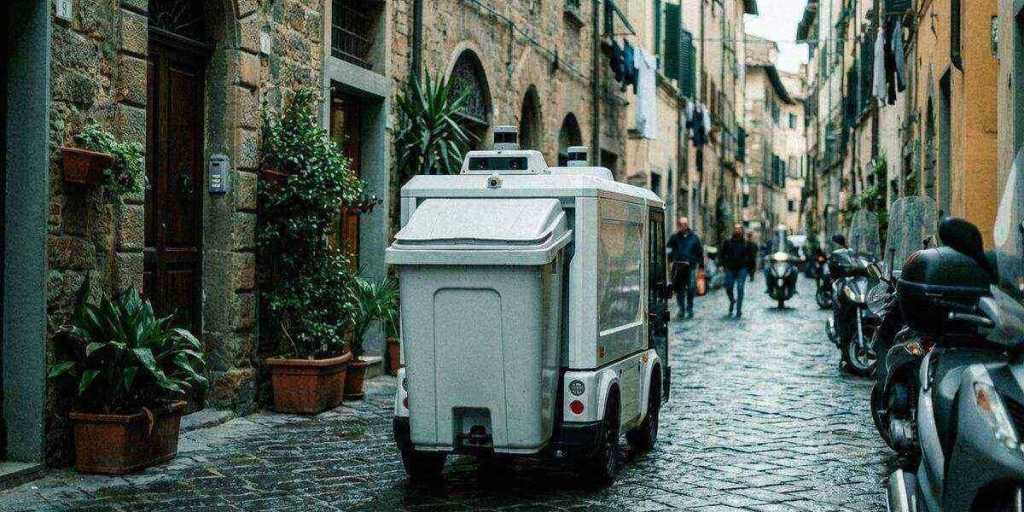
Specifications
| Manufacturer | Scuola Superiore Sant'Anna / Robotnik Automation |
|---|---|
| Application | On-demand household waste collection |
| Status | Research prototype (project concluded 2009) |
| Year | 2007 |
| Country | Italy / Spain |
| Weight | ~60 kg |
| Autonomy Level | Full autonomous navigation with remote monitoring |
Overview
DustCart was one of two autonomous platforms developed within the EU FP6 DustBot project (2006–2009). Designed for on-demand household waste collection in pedestrian areas, it represented one of the earliest attempts to deploy an autonomous service robot in a real urban setting with real users.
Design and Dimensions
DustCart weighed approximately 60 kilograms and stood roughly 1.2 metres tall — about the height of a parking meter. Its footprint was compact enough to navigate streets as narrow as 2 metres, which was a hard requirement for operating in Peccioli‘s medieval town centre.
The robot’s chassis was designed by Robotnik Automation in Valencia, Spain, and integrated with navigation, communication, and waste-handling subsystems developed by the broader consortium. It moved on wheels using differential drive — two independently powered wheels plus casters for stability — giving it the ability to turn on the spot in tight spaces.
Navigation System
DustCart’s navigation relied on three primary sensor inputs:
- Differential GPS — a local base station provided real-time corrections, achieving ~2 cm positioning accuracy
- Laser rangefinder — a 2D LiDAR unit (likely SICK LMS series) for obstacle detection and map-based localisation
- Inertial measurement unit — accelerometers and gyroscopes for bridging GPS gaps in narrow streets
These inputs were fused using an Extended Kalman Filter to produce a continuous position estimate. The navigation architecture used a three-layer hierarchy: topological global planning, metric trajectory following, and reactive obstacle avoidance.
Operational Model
DustCart’s defining feature was its on-demand service model. Residents telephoned a dedicated number to request waste collection. The request was routed to a central control system, which dispatched the nearest available robot to the caller’s address. The robot navigated autonomously to the pickup location, accepted the waste, and transported it to a collection depot.
This model was structurally similar to what modern delivery robots do today — receive a request, navigate to a location, complete a task, return to base — but in reverse (collecting rather than delivering).
Communication
DustCart maintained connectivity through a hybrid communication architecture: a Wi-Fi mesh network with cellular fallback. The mesh provided primary data links within the operating area; cellular connectivity served as a backup in areas beyond mesh coverage.
Field Trials
DustCart was primarily tested in Peccioli, Italy. The trials demonstrated autonomous navigation in unstructured pedestrian environments, successful completion of on-demand collection tasks, and acceptable interaction with non-expert users. Limitations included restricted operating hours (the robot could not operate in darkness due to GPS requirements and safety considerations) and the need for a flat, unobstructed route between pickup and depot.
Legacy
DustCart did not become a commercial product, but it proved that on-demand autonomous services in pedestrian environments were technically feasible. Its DNA is visible in the Starship and Nuro platforms that followed a decade later.
References
- Ferri, G. et al. (2011). “DustCart, an autonomous robot for door-to-door garbage collection.” IEEE ICRA 2011.
- Salvini, P. et al. (2011). “The Robot DustCart.” IEEE Robotics & Automation Magazine.