 DustBot
How Street Cleaning Robots Evolved from Concept to Commercial Product
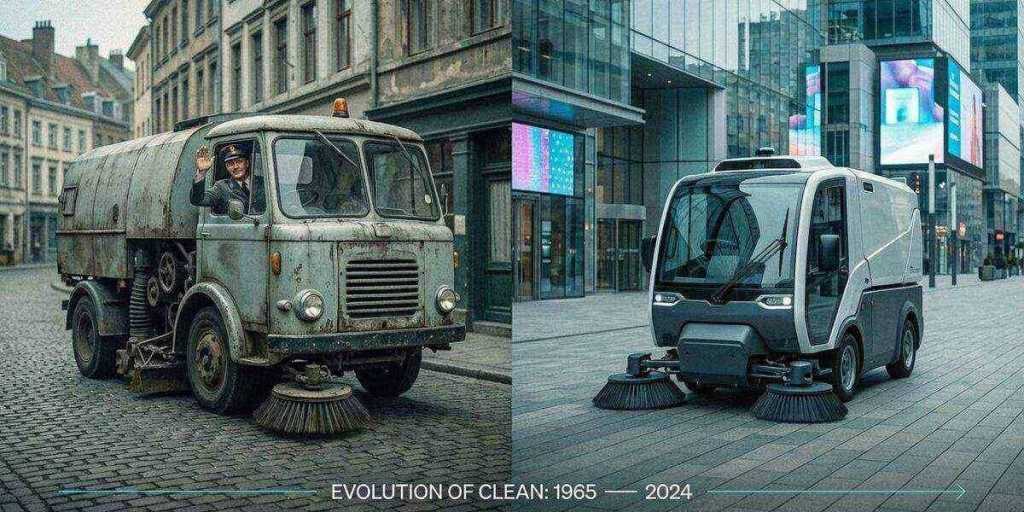
Before the Robots
Mechanical street sweeping dates back to 1843, when Joseph Whitworth patented a horse-drawn sweeping machine in Manchester. By the early twentieth century, motorised sweepers were common in European and American cities. These machines grew larger and more efficient over the decades, but they shared a fundamental limitation: they required a human driver.
The idea of automating street cleaning emerged in the 1990s, roughly concurrent with the first serious research into outdoor mobile robots. The motivation was not futuristic ambition but practical economics. Street sweeping is repetitive, physically demanding, and difficult to staff — particularly for night shifts and in harsh weather conditions.
Early Research: 1990s–2005
Academic interest in autonomous cleaning robots predates DustBot by several years. The AMOS project at the Technical University of Munich explored autonomous outdoor cleaning platforms in the late 1990s. In Japan, several university groups investigated robotic systems for maintaining public spaces, driven by the country’s demographic concerns.
These early projects demonstrated that the core technologies — GPS localisation, obstacle detection, sweeping mechanisms — could be integrated on a single platform. What they did not demonstrate was robustness. Prototypes worked in controlled tests but failed when exposed to the unpredictability of real streets.
DustBot and DustClean: 2006–2009
The DustBot project, launched in December 2006 under EU Framework Programme 6, made a deliberate decision to test in uncontrolled environments. DustClean, the project’s sweeping platform, was designed to clean pedestrian areas autonomously while simultaneously monitoring air quality.
DustClean’s onboard sensor array measured nitrogen oxides (NOx), sulphur dioxide (SO2), ozone (O3), benzene, and carbon monoxide/dioxide concentrations. This dual-purpose design — cleaning and monitoring — was novel. Previous cleaning robots had treated the task as purely mechanical. DustBot treated it as an opportunity to gather environmental data that municipalities would otherwise need separate monitoring stations to collect.
Field tests in Peccioli and the other trial sites showed that autonomous sweeping was technically feasible, though battery life and cleaning thoroughness remained areas for improvement. The environmental monitoring capability attracted considerable interest from municipal authorities.
The Commercial Gap: 2010–2018
After DustBot concluded in November 2009, there followed a period of relative quiet in autonomous street cleaning. The technology existed in prototype form, but no manufacturer brought a commercial product to market. The reasons were primarily economic: the cost of the sensor suite, the limited battery life, and the lack of a regulatory framework for autonomous machines on public streets made the business case uncertain.
Indoor cleaning robots, by contrast, advanced rapidly during this period. Companies like iRobot (Roomba) and Ecovacs demonstrated that autonomous cleaning had consumer market potential, while commercial indoor cleaning robots from companies like Brain Corp. and Avidbots found niches in airports and shopping centres.
The Current Generation: 2019–Present
The past five years have seen a decisive shift. Several companies have brought autonomous outdoor cleaning robots to market:
- Gaussian Robotics (Shenzhen, China) — produces a range of autonomous cleaning robots for both indoor and outdoor use. Their outdoor sweeper uses LiDAR and camera fusion for navigation.
- Trombia Technologies (Helsinki, Finland) — the Trombia Free is a fully autonomous street sweeper designed for Nordic conditions, including snow and ice.
- Enway (Berlin, Germany) — provides autonomous driving software for existing sweeper hardware, a retrofit approach that reduces upfront costs.
- Idriverplus (Beijing, China) — operates autonomous sweepers in several Chinese cities, with reported fleets exceeding 1,000 units.
These products exist because the enabling technologies became affordable. A multi-beam LiDAR unit that cost 75,000 USD in 2010 can now be replaced by a solid-state equivalent costing under 1,000 USD. Lithium iron phosphate batteries provide the energy density needed for full-shift operation. And 4G/5G networks eliminate the need for dedicated communication infrastructure.
From the Lab: Watching a Trombia
I observed a Trombia Free operating at a logistics park outside Helsinki in late 2024. The machine is larger than DustClean was — roughly the size of a compact car — and vastly more capable. It swept a 12,000-square-metre area in just over an hour, autonomously navigating around parked lorries, bollards, and a rather startled fox. The contrast with the DustBot-era prototypes was striking, not because the fundamental approach had changed, but because everything was faster, quieter, and more reliable. Fifteen years of incremental improvement had turned a research demonstrator into a product.
What DustBot Got Right
Looking back, the DustBot project made two decisions that proved prescient. First, integrating environmental monitoring with cleaning. Modern smart city initiatives routinely combine functions on autonomous platforms — air quality sensing, noise monitoring, and infrastructure inspection alongside the primary cleaning task. Second, designing for on-demand operation rather than fixed schedules. The current trend toward responsive, data-driven municipal services echoes DustBot’s phone-based request system, updated for the smartphone era.