 DustBot
DustBot Project Brochure: Technical Summary and Specifications
Project Summary
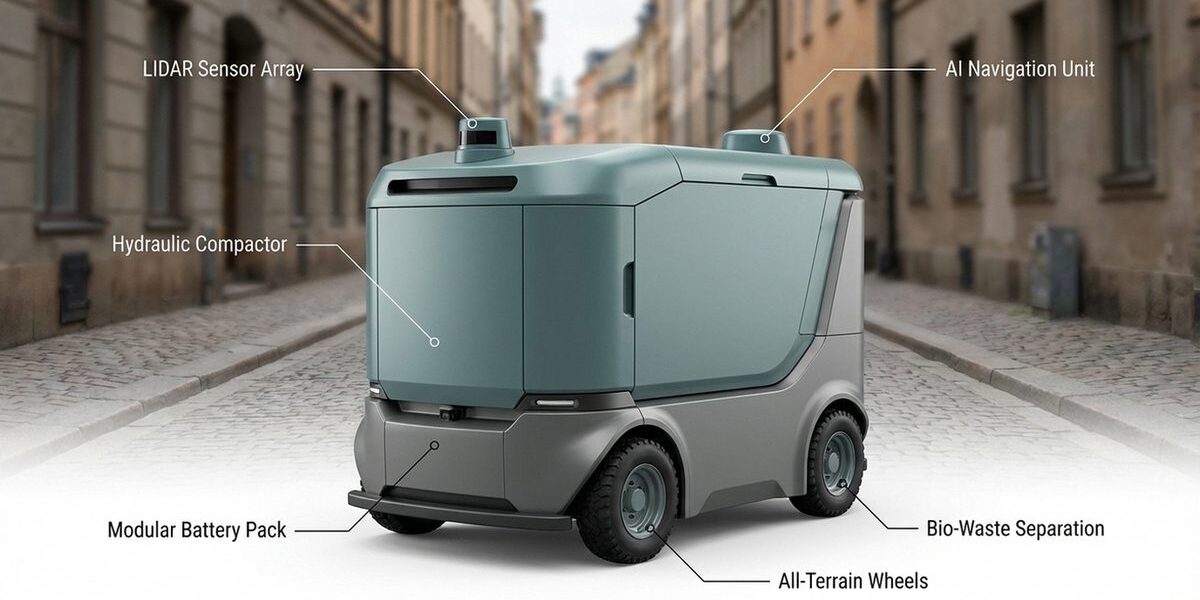
The DustBot project (FP6-045299) developed two autonomous robot platforms for urban hygiene services: DustCart for on-demand waste collection and DustClean for street sweeping with environmental monitoring. Funded under the EU 6th Framework Programme, the project ran from December 2006 to November 2009 and was coordinated by Scuola Superiore Sant’Anna in Pisa.
DustCart Specifications
| Parameter | Value |
|---|---|
| Weight | ~60 kg |
| Height | ~1.2 m |
| Maximum speed | ~5 km/h |
| Navigation | Differential GPS + laser rangefinder + IMU |
| Positioning accuracy | ~2 cm (DGPS) |
| Communication | Wi-Fi mesh + cellular (GPRS/UMTS) |
| Task interface | Telephone-based request system |
| Operating environment | Pedestrian streets, pavements |
DustClean Specifications
| Parameter | Value |
|---|---|
| Function | Autonomous street sweeping + air quality monitoring |
| Navigation | 2D laser SLAM + GPS |
| Gas sensors | NOx, SO2, O3, benzene, CO, CO2 |
| Sensor type | Electrochemical + metal oxide semiconductor |
| Data output | Geo-referenced gas distribution maps |
| Communication | Wi-Fi mesh + cellular fallback |
Field Trial Sites
- Peccioli, Italy — Primary demonstration site. Medieval hilltop town with narrow streets unsuitable for conventional waste trucks. Population ~5,000.
- Bilbao, Spain — Mixed pedestrian-vehicle environment. Tested robot performance in Atlantic climate conditions (high rainfall).
- Örebro, Sweden — Environmental monitoring focus. Tested gas sensing capability in Scandinavian conditions.
- Osaka, Japan — Cross-cultural HRI study. Compared user responses with European trial sites.
Consortium
Nine partners across five countries: Scuola Superiore Sant’Anna (coordinator, Italy), University of Florence (Italy), CNIT (Italy), Örebro University (Sweden), Robotnik Automation (Spain), Peccioli Municipality (Italy), and partners from the UK and Switzerland.
Publications
The project produced over 40 peer-reviewed publications. Key venues included IEEE/RSJ International Conference on Intelligent Robots and Systems (IROS), IEEE Global Communications Conference (Globecom), and the journal Autonomous Robots. See the Research section for summaries.
Funding
DustBot was funded under the European Commission’s 6th Framework Programme for Research and Technological Development (FP6), ICT priority. The EU contribution was approximately 3 million EUR.
For a narrative account of the project’s history and impact, see the full project overview.