 DustBot
How the DustBot Project Pioneered Urban Service Robotics
Project at a Glance
| Full title | Networked and Cooperating Robots for Urban Hygiene |
| Project code | FP6-045299 |
| Programme | EU 6th Framework Programme (FP6) |
| Duration | December 2006 – November 2009 (36 months) |
| Total budget | Approximately 3 million EUR (EU contribution) |
| Coordinator | Scuola Superiore Sant’Anna (SSSA), Pisa, Italy |
| Partners | 9 institutions across Italy, Sweden, Spain, UK, Switzerland |
Consortium Partners
The DustBot consortium brought together expertise in robotics, wireless communications, environmental sensing, and municipal services:
- Scuola Superiore Sant’Anna (Pisa, Italy) — project coordinator; robot design and integration
- University of Florence (Italy) — communication systems and networking
- Örebro University (Sweden) — gas sensing and distribution mapping
- Consorzio Nazionale Interuniversitario per le Telecomunicazioni (CNIT) (Italy) — telecommunications infrastructure
- Robotnik Automation (Valencia, Spain) — mobile robot platform engineering
- Peccioli Municipality (Italy) — field trial site and end-user requirements
- Additional partners from the UK and Switzerland contributing to HRI research and environmental monitoring
Two Robots, Two Tasks
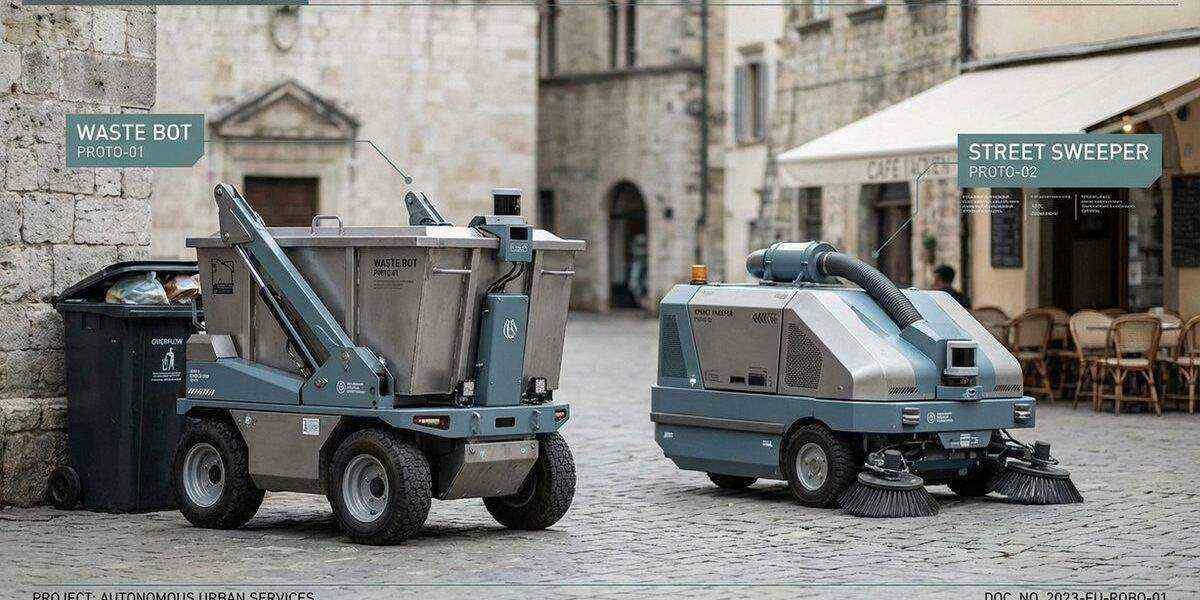
The project developed two complementary platforms:
DustCart — On-Demand Waste Collection
DustCart was an autonomous mobile robot designed to collect household waste from individual residents. Weighing approximately 60 kg and standing about 1.2 metres tall, it navigated pedestrian streets using differential GPS and laser rangefinders. Residents requested collections by telephone; the robot would navigate to their location, accept the waste, and transport it to a collection point.
DustClean — Autonomous Street Sweeping
DustClean was designed for autonomous sweeping of pedestrian areas. Beyond its cleaning function, it carried an array of environmental sensors monitoring NOx, SO2, ozone, benzene, CO, and CO2, producing gas distribution maps of its operating area.
Field Trials
The project conducted field tests at four locations:
- Peccioli, Italy — the primary trial site, where DustCart performed on-demand waste collection in the historic town centre
- Bilbao, Spain — testing in mixed pedestrian-traffic zones with different urban geometry
- Örebro, Sweden — environmental monitoring trials in Scandinavian conditions
- Osaka, Japan — human-robot interaction studies in a culturally distinct context
These geographically diverse trials were deliberate. The consortium wanted to demonstrate that the system could function across different climates, urban layouts, cultural contexts, and regulatory environments.
Key Technical Achievements
- Demonstrated autonomous navigation on narrow, uneven pedestrian streets with real traffic
- Achieved 2 cm positioning accuracy using differential GPS in outdoor urban environments
- Implemented an on-demand service model with telephone-based request handling
- Built mobile gas distribution mapping capability on an autonomous platform
- Designed a hybrid mesh-cellular communication architecture for robot fleet connectivity
- Produced over 40 peer-reviewed publications across multiple disciplines
Research Output
The DustBot consortium’s publications covered a wide range of topics. Key contributors included Barbara Mazzolai and Virgilio Mattoli (robot design, SSSA), Achim Lilienthal (gas sensing, Örebro), Romano Fantacci and Dania Tacconi (communications, Florence), and Paolo Dario (principal investigator, SSSA).
For detailed summaries of specific publications, see the Research section.
Legacy
DustBot concluded in November 2009. No direct commercial product emerged from the project, which is typical for EU framework programme research. Its impact was in demonstrating feasibility and training a generation of researchers who went on to work in service robotics.
The concepts DustBot validated — on-demand robotic services, mobile environmental monitoring, fleet communication architectures — are now standard features of commercial platforms from companies like Starship, Gaussian Robotics, and Trombia. The project was, in a real sense, fifteen years ahead of its market.
Sources and Further Reading
- Ferri, G. et al. (2011). “DustCart, an autonomous robot for door-to-door garbage collection.” IEEE ICRA 2011.
- Salvini, P. et al. (2011). “The Robot DustCart.” IEEE Robotics & Automation Magazine.
- DustBot on CORDIS — EU project database entry.