 DustBot
How Delivery Robots Are Reshaping Last-Mile Logistics
The Last-Mile Problem
In logistics, the “last mile” refers to the final leg of delivery — from a distribution hub to the customer’s door. It is, by a wide margin, the most expensive stage of the supply chain. Estimates from McKinsey and DHL consistently place last-mile costs at 40–50% of total shipping cost for e-commerce orders.
The reasons are structural. Last-mile delivery requires navigating residential streets, finding specific addresses, dealing with absent recipients, and handling the sheer diversity of delivery locations. A single driver might make 150 stops per shift, each requiring parking, walking, and ringing a doorbell. The labour intensity is enormous.
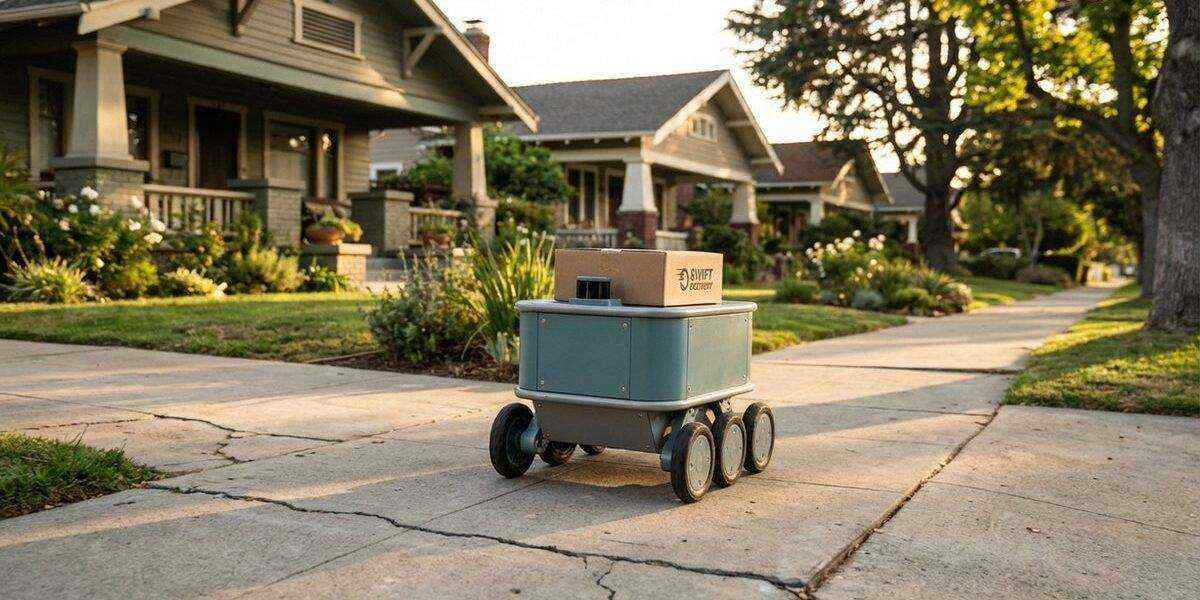
Autonomous delivery robots aim to automate some or all of this process. The concept did not begin with today’s well-funded startups — it traces back, in part, to projects like DustBot, which demonstrated that small autonomous robots could navigate real urban streets and respond to individual service requests.
DustBot’s On-Demand Model
DustCart was not a delivery robot. It collected waste rather than delivering packages. But its operational model — receiving a request by phone, navigating to the requester’s location, completing a task, and returning to base — is structurally identical to what Starship, Nuro, and their competitors do today.
The DustBot project demonstrated several capabilities that would prove essential for delivery robots: autonomous navigation on pavements, obstacle avoidance around pedestrians, communication with a central dispatch system, and — perhaps most importantly — public acceptance. Residents of Peccioli called the robot for service and waited for it to arrive. That interaction model required trust, and the project showed it could be built.
The Current Landscape
Pavement delivery robots operate in a handful of distinct form factors:
- Small cooler-sized robots — Starship Technologies’ six-wheeled units are the most widely deployed example. They weigh roughly 23 kg empty, carry up to 10 kg of cargo, and travel at walking speed on pavements.
- Road-going pods — Nuro’s R3 is a purpose-built vehicle with no passenger cabin, operating on public roads at speeds up to 45 mph. It carries groceries, prescriptions, and prepared meals.
- Drone delivery — Wing (Alphabet) and Amazon Prime Air use aerial drones for direct-to-garden deliveries, bypassing street-level navigation entirely.
Each approach has trade-offs. Pavement robots are slow but cheap and safe. Road pods are faster but face stricter regulatory requirements. Drones are fastest but limited by weather, payload weight, and noise regulations.
Technical Comparisons
| Feature | DustCart (2007) | Starship (2024) | Nuro R3 (2024) |
|---|---|---|---|
| Weight | ~60 kg | ~23 kg (empty) | ~630 kg |
| Speed | ~5 km/h | ~6 km/h | ~72 km/h |
| Navigation | DGPS + laser | 9 cameras + GPS + IMU | LiDAR + cameras + radar |
| Connectivity | Ad-hoc mesh | 4G cellular | 5G cellular |
| Operating area | Pavements | Pavements | Public roads |
| Cargo | Waste bin | Package compartment | Dual cargo bays |
Economics of Robotic Delivery
The economic case for delivery robots rests on labour cost replacement. A human driver delivering parcels costs roughly 25–35 GBP per hour when accounting for wages, vehicle costs, fuel, and insurance. A delivery robot’s marginal cost per delivery, once the fleet is deployed, is estimated at 1–3 GBP — though this figure depends heavily on fleet utilisation, remote supervision costs, and maintenance.
The break-even point is not yet clear for most operators. Starship has achieved profitability in some campus deployments but not in all urban markets. Nuro has invested heavily in its autonomous driving stack, with commercial sustainability still on the horizon.
From the Lab: A Question of Speed
When I first read about DustCart’s 5 km/h operating speed, I thought it was a limitation. Having since watched Starship robots navigate busy university campuses at similar speeds, I have changed my view. Slow speed is a feature, not a bug. It makes the robot predictable to pedestrians, reduces the severity of any collision, and simplifies the computational demands on the navigation system. DustBot’s engineers chose that speed deliberately, and the industry followed.
Regulatory Progress
Delivery robot regulation has advanced significantly since DustBot operated in a regulatory void. Key developments include:
- Estonia (2017) — first national legislation permitting delivery robots on pavements
- United States — over 20 states have passed legislation permitting personal delivery devices
- United Kingdom — the Automated Vehicles Act 2024 provides a framework for autonomous delivery, with specific provisions for low-speed pavement robots
- European Union — the 2019 Vehicle General Safety Regulation has been supplemented by ongoing work on urban autonomous mobility
What DustBot Anticipated
The DustBot consortium’s 2006 proposal described a vision where autonomous robots would provide multiple urban services on demand. Delivery was not the specific application, but the infrastructure — navigation, communication, fleet coordination, public interaction — was the same. The project proved the concept fifteen years before the market was ready for it.