 DustBot
How Robots Are Entering Urban Environments
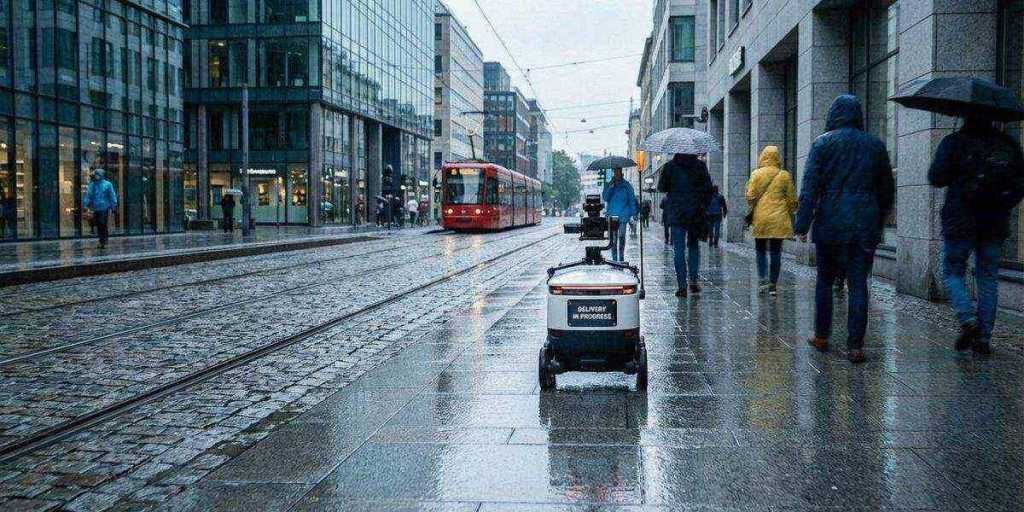
Cities Were Not Designed for Robots
A modern city is an obstacle course optimised for humans: narrow pavements, uneven surfaces, traffic lights that communicate through colour, pedestrian flows governed by social norms rather than protocols. Deploying an autonomous robot in this environment means confronting every assumption that makes factory robotics tractable.
The DustBot project understood this from the start. Its field trials deliberately targeted difficult urban settings — Peccioli’s medieval streets, Bilbao’s mixed pedestrian-traffic zones, and even Osaka’s dense urban fabric — to test whether autonomous service robots could function where people actually live.
The Peccioli Model
Peccioli is a town of roughly 5,000 people in Tuscany. Its historic centre has streets too narrow for conventional waste collection trucks, which is precisely what made it an ideal testbed. Residents would phone a dedicated number to request waste collection. DustCart would navigate to their location, collect the waste, and return to a deposit point.
This on-demand model differed from traditional scheduled collection in a fundamental way: the robot responded to individual requests rather than following a fixed route. It required robust communication infrastructure, reliable navigation, and enough intelligence to prioritise and sequence multiple requests efficiently.
Regulatory and Social Barriers
Technical capability is only half the story. Autonomous robots on public streets face regulatory challenges that vary enormously between jurisdictions. When DustBot began in 2006, there was essentially no regulatory framework for pavement robots anywhere in Europe.
Since then, progress has been uneven. Estonia became one of the first countries to legislate for delivery robots on pavements in 2017. The UK conducted extensive trials under the Automated and Electric Vehicles Act 2018. In the United States, regulations vary by state, with some permitting pavement robots up to certain weight limits and others requiring a human chaperone within a specified distance.
Social acceptance is equally variable. The DustBot consortium’s HRI (human-robot interaction) studies in Peccioli and Osaka found generally positive attitudes, but with significant cultural differences. Italian residents were curious and engaged; Japanese participants were polite but more cautious about physical proximity to the robot.
Infrastructure Requirements
An autonomous robot cannot simply be placed on a street and expected to function. The DustBot project required:
- A differential GPS base station installed in Peccioli with line-of-sight coverage across the operating area
- Wireless communication nodes providing continuous data links between the robot, the control centre, and the telephone request system
- Mapped environments — detailed digital maps of every street and obstacle the robot might encounter
- Charging and maintenance stations — the robot had limited battery life and needed regular servicing
Modern systems have reduced some of these requirements. Cloud-based mapping, ubiquitous 4G/5G coverage, and improved battery technology mean that a robot like Starship needs less dedicated infrastructure. But the principle holds: deploying robots in cities requires preparation beyond the robot itself.
From the Lab: Bilbao’s Rain
A colleague who worked on the DustBot field trials in Bilbao once told me about the rain problem. The Basque Country receives over 1,200 mm of rainfall annually. DustClean’s laser rangefinder would occasionally interpret heavy rain as a dense field of obstacles, causing the robot to halt. The team eventually added a rain detection threshold to the sensor processing pipeline — a software fix for a fundamentally hardware problem. It was inelegant, but it worked. Real-world robotics is full of such compromises.
Current Deployments
As of 2026, autonomous robots operate on public streets in dozens of cities worldwide. Starship Technologies has completed millions of deliveries across university campuses and residential areas. Nuro operates driverless delivery vehicles on public roads in several US states. Gaussian Robotics and Trombia have deployed commercial cleaning robots in airports, shopping centres, and outdoor environments.
These are not research prototypes. They are commercial products generating revenue, collecting data, and gradually proving that the concept DustBot demonstrated in 2007 — autonomous robots providing municipal services — was ahead of its time rather than wrong.
What Comes Next
The next frontier is coordination. Individual robots navigating individual streets is largely a solved problem. Fleets of robots sharing a city with pedestrians, cyclists, cars, and each other is not. Multi-robot task allocation, fleet-level path planning, and shared situational awareness are active research areas that will determine whether urban service robots scale from novelty to utility.
The DustBot project envisioned exactly this: a networked system of cooperating robots. Its 2006 proposal described a fleet of DustCarts and DustCleans sharing information and coordinating tasks. The technology of the time limited what could be achieved. The technology of today is catching up to the vision.