 DustBot
What Are Autonomous Service Robots?
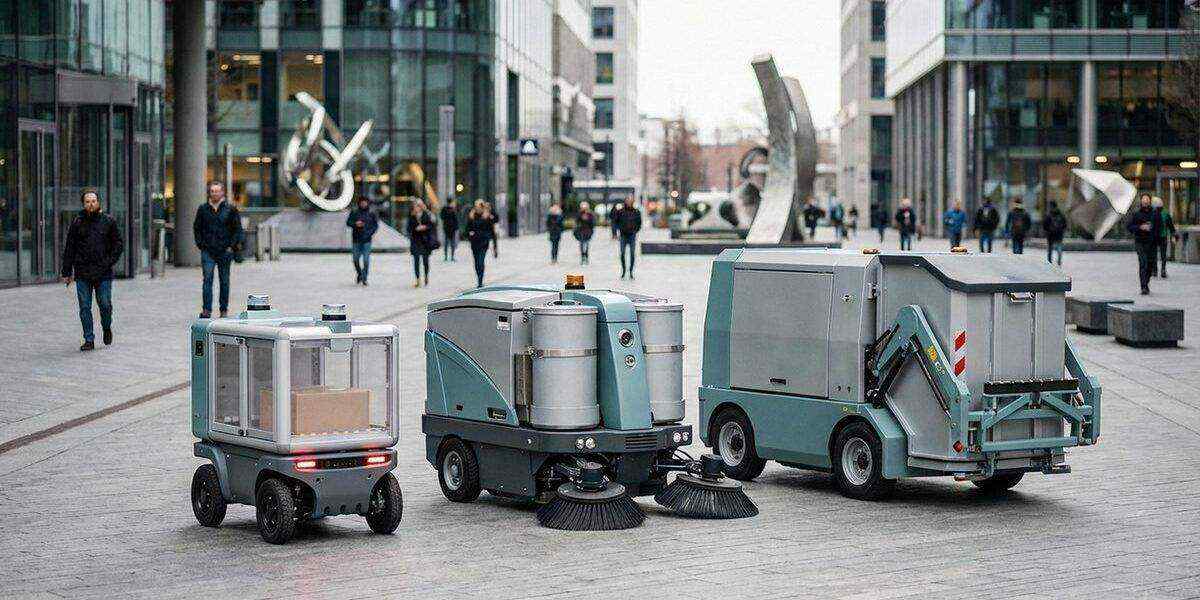
Defining the Category
A service robot, as defined by the International Federation of Robotics (IFR), is a robot that performs useful tasks for humans or equipment, excluding industrial automation applications. Strip away the committee language and you get something clearer: a machine that works alongside people rather than behind a factory fence.
The distinction matters. Industrial robots — the welding arms on a car assembly line, the pick-and-place units in a warehouse — operate in controlled environments designed around their needs. Service robots do the opposite. They enter human spaces and adapt to them.
Categories of Service Robots
The IFR divides service robots into two broad groups:
- Professional service robots — designed for commercial tasks. Examples include hospital logistics robots, agricultural drones, inspection platforms for infrastructure, and the DustCart waste collection robot.
- Personal service robots — used by non-experts in domestic or leisure settings. Robotic vacuum cleaners, lawn mowers, and social companion robots fall into this category.
The boundary between the two is not always firm. A delivery robot like Starship serves commercial operators but interacts with individual consumers on pavements and doorsteps.
What Makes Them Autonomous?
Autonomy in service robotics exists on a spectrum. At one end, a remote-controlled bomb disposal unit is a service robot with zero autonomy — every movement is dictated by a human operator. At the other end, a robot that plans its own routes, avoids obstacles, and makes task decisions without human input operates with full autonomy.
Most real-world service robots sit somewhere in between. The DustBot project’s DustClean platform, for instance, could follow pre-programmed cleaning paths and avoid obstacles autonomously, but a human operator could override its decisions remotely. This is sometimes called supervised autonomy or shared control.
The key enabling technologies for autonomous operation include:
- Localisation — knowing where the robot is. Techniques include GPS, visual odometry, and SLAM (Simultaneous Localisation and Mapping).
- Perception — understanding the environment. LiDAR, cameras, ultrasonic sensors, and radar all contribute.
- Planning — deciding what to do. Path planning algorithms, task schedulers, and increasingly machine learning models.
- Actuation — executing decisions physically. Motors, manipulators, and specialised tools like sweeping brushes or waste compartments.
From the Lab: My First Encounter
I remember the first autonomous service robot I worked with during my PhD at Cambridge — a modified Pioneer 3-DX that we had fitted with a cheap GPS module and a forward-facing camera. The task was simple: navigate across a courtyard and stop at a designated point. It took us three weeks to get it working reliably, and even then a passing cyclist would confuse the obstacle avoidance system badly enough to trigger a full stop.
That experience gave me a deep respect for what the DustBot team achieved in Peccioli. Navigating a real town with real pedestrians, parked cars, and uneven cobblestone streets is orders of magnitude harder than crossing a university courtyard.
The Market Today
The IFR estimated the professional service robot market at roughly 20.5 billion USD in 2023, with logistics and delivery robots accounting for the largest share. The segment has grown considerably since DustBot’s era, driven by improvements in LiDAR costs, battery technology, and computational power.
Municipal service robots — the category DustBot pioneered — remain a smaller niche, but companies like Gaussian Robotics and Trombia have brought commercial products to market. The gap between research prototype and deployed product, which was vast in 2009, has narrowed significantly.
Why It Matters
Autonomous service robots are not a curiosity. In ageing societies with shrinking workforces — Japan, South Korea, much of Western Europe — they address a genuine labour gap. Municipal cleaning, waste collection, and environmental monitoring are physically demanding jobs with chronic recruitment problems.
The DustBot project recognised this in 2006. Its proposal explicitly cited demographic trends as a motivating factor. Nearly two decades later, those trends have only intensified.
Further Reading
For more on DustBot’s specific contributions, see the project overview. For a deeper look at how these robots find their way, read our guide on autonomous navigation.